
Attending SuperAI opens doors to rich insights: code demos, workshop walkthroughs, architectural patterns, prompt engineering tricks, and experiment results. But those insights lose impact if they stay locked in your head or local machine. Publishing your learnings on GitHub transforms them into reusable knowledge, builds credibility, and helps others in the community. This article walks you through how to turn your SuperAI learnings into polished GitHub projects that others will appreciate.
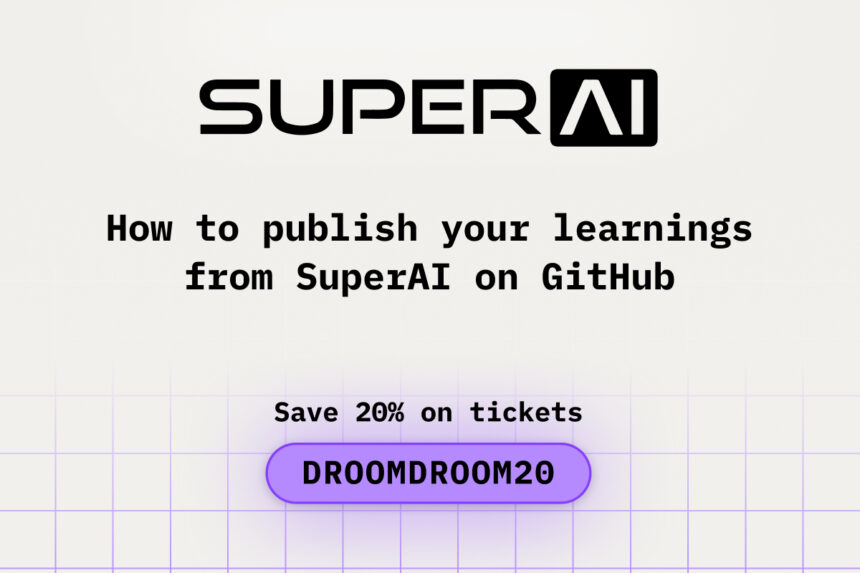
Use DROOMDROOM20, the official SUPERAI promo code, to get 20% off ticket prices.
1. Choose the Right Format for Your Repository
Your first decision is to select how you’ll structure your learnings. Common formats include:
- Workshop tutorial repo: Code + markdown explanations, step-by-step guide
- Experiment repository: Jupyter notebooks or scripts with results, comparisons, and commentary
- Demo showcase: A mini app or web demo with a front end, backend, and README that explains how it works
- Combined content + code: Use GitHub Pages or markdown docs to host explanatory content alongside code. As many developers recommend, you can host tutorials in Markdown and link them to code in the same repo.
Pick a format that matches what you learned (e.g. if there was a UI demo, a mini app makes sense; if it was a data experiment, Jupyter notebooks might suffice).
2. Structure & Document Your Repository Thoughtfully
A well-structured GitHub repo helps others understand and build on your work. Key elements include:


- README.md at the root: include project name, purpose, prerequisites, setup steps, usage examples
- LICENSE file: choose an open source license (e.g. MIT, Apache) so others know how they may reuse your materials
- CONTRIBUTING.md: instruct how others can contribute back
- Directory layout: separate code, scripts, data, notebooks, assets
- Dependencies file: e.g. requirements.txt (for Python) or package.json (for Node) to list libraries used
- Examples or demo folder: show working snapshots or small sample inputs
- Tests or validation scripts (if applicable): basic sanity checks give confidence
Also, follow GitHub best practices: keep repository focused (avoid committing bulky binaries) and use .gitignore to skip local/trash files.
When your repository is clean and documented, it’s far more likely to be starred, forked, or shared.
Claim your 20% discount on SUPERAI tickets by entering the official promo code DROOMDROOM20.
3. Version Control, Branching, and Releases
When publishing your learnings:
- Use branches: keep main or master stable and use feature branches for experiments
- Commit regularly with meaningful messages (e.g. “Add prompt tuning comparison”, “Fix model serialization bug”)
- Tag or release stable versions: mark milestones (v1.0, v1.1) so users can grab stable snapshots
- Maintain a clean commit history, possibly using squash or rebase as needed
These practices help people follow your evolution and replicate your experiments. In academic contexts, publishing code alongside publications is encouraged after public release.
Use the official SUPERAI promo code DROOMDROOM20 now and save 20% on your ticket.
4. Write Rich Documentation & Examples
Your code may work, but documentation is what makes it usable by others:
- Use Markdown files to explain your approach step by step
- Embed code snippets and visual outputs (graphs, screenshots)
- Create example notebooks or usage scripts
- Explain tradeoffs, failure modes, and limitations
- Reference SuperAI session names or workshop titles to give context for your audience
Many developers advocate combining tutorials in Markdown in the repo itself, so explanations and code stay coherent.
5. Use GitHub Pages or Wiki for Better Presentation
To make your project more discoverable:
- Enable GitHub Pages to host a website version of your repository (tutorials, demo pages, interactive docs)
- Or use the wiki to elaborate on designs, long-form explanations, or collaborator contributions
This gives readers a browser-friendly interface, complementing raw code.
6. Promote & Share Your Repository
Publishing is just step one. To maximize reach:
- Share links on social media, dev forums, and relevant communities
- Tag SuperAI, workshop speakers, or project collaborators
- Post short snippets or highlights (images, GIFs) to attract attention
- Monitor feedback, accept pull requests, and iterate
- Encourage others to clone, fork, remix, or build upon your work
High visibility can lead to collaborations, speaking invites, or role offers.
Why It’s Worth Doing
Publishing your SuperAI learnings helps in multiple ways:
- It anchors your expertise and improves your reputation
- It lets others replicate or build on your insights
- It increases visibility and opens doors to collaboration
- It’s a reference you can show to prospective employers, clients, collaborators
Moreover, SuperAI has an active GitHub presence: for example, the official super.ai organization hosts superai-sdk, documentation-demo, and other repositories publicly. This means publishing in that ecosystem increases synergy and discoverability.
Conclusion
Your SuperAI experience holds lessons worth capturing—not just mentally, but in code. Publishing your learnings on GitHub transforms them into a resource for others while showcasing your growth. Choose the right format, document clearly, version cleanly, present well, and promote smartly. If you build trust and polish into your repository, it can become a lasting artifact of your SuperAI journey.
Apply DROOMDROOM20, the official SUPERAI promo code, to enjoy a 20% ticket discount